
Decision Guide
Start with the license: every commercial pest control business location in Illinois must be licensed by the Illinois Department of Public Health and employ at least one certified technician. Then ask about insurance, how they'll identify and treat the pest, what products they'll use and what precautions to take, what follow-up is included, and the full price.
Published 2026-10-12 · Updated 2026-10-12
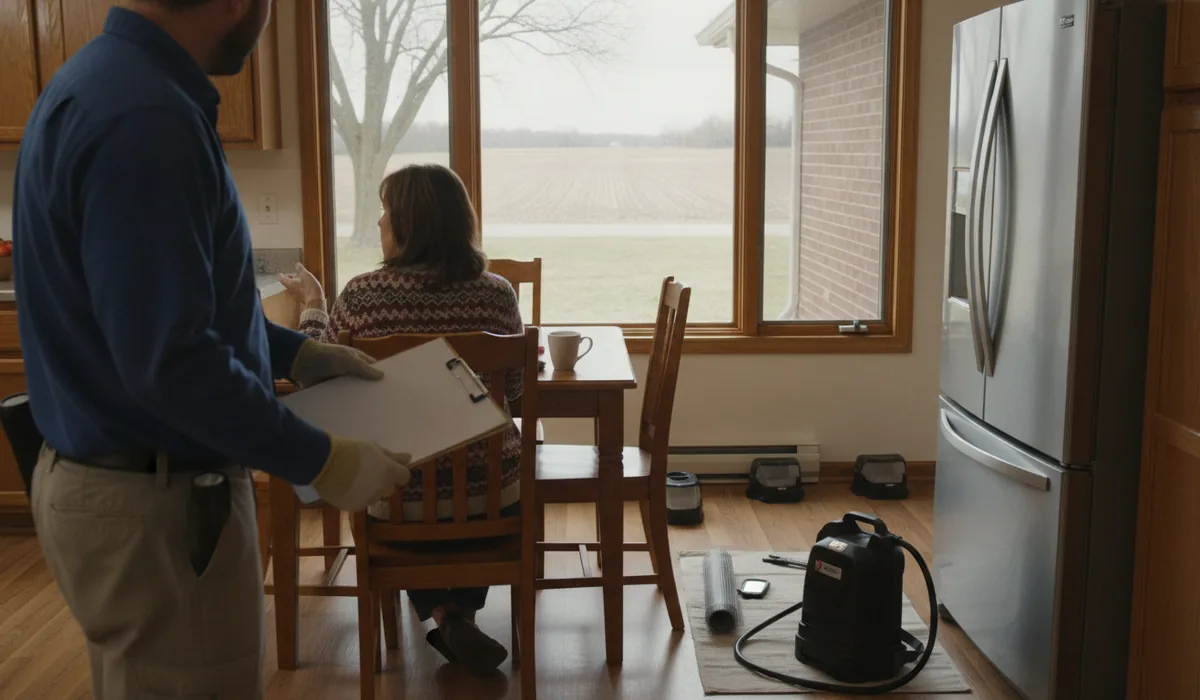
Illinois regulates pest control more tightly than many trades, which makes it easier to check a company before you let them treat your home. Here’s what to ask, and why.
1. “Are you licensed by IDPH, and what’s the license number?”
Under the Illinois Structural Pest Control Act, it is unlawful to operate a commercial structural pest control business at any location in Illinois without a license from the Illinois Department of Public Health, and each business location needs its own license. IDPH reports about 750 licensed business locations statewide.
Ask for the license number, then look it up in IDPH’s Pest Control Business Search, linked from the program page. Confirm the business name and that the license is current.
2. “Who is the certified technician?”
IDPH says a business must employ at least one certified technician. Technician certification requires passing an exam and is renewed every three years. Ask who the certified technician is and whether that person, or someone working under their supervision, will do your treatment.
3. “What insurance do you carry?”
The Act (225 ILCS 235/9) requires a licensed business to carry public liability coverage of at least $100,000 per person or $300,000 per occurrence for injuries, and $50,000 per occurrence for property damage. Asking for a certificate of insurance is reasonable.
4. “How will you identify the pest and the cause?”
A good provider inspects before treating: what the pest is, how it’s getting in, and what’s attracting it. The EPA recommends choosing a company with experience in integrated pest management (IPM), which combines prevention, sealing, sanitation, and targeted treatment rather than relying on spraying alone.
5. “What products will you use, and what precautions should we take?”
Ask what will be applied, where, and how long children and pets should stay out of treated areas. Providers must follow product labels. Be wary of anyone who says a product is completely harmless; no pesticide treatment is risk-free.
6. “What’s included, and what’s the price?”
- How many visits, and are re-treatments between scheduled visits free?
- Is exclusion (sealing entry points) included or extra?
- For plans: contract length, cancellation terms, and automatic renewal.
- For termites: what the warranty covers (re-treatment only, or damage repair), and the renewal fee.
Get it in writing. HomeAdvisor’s June 2026 national data puts the average pest control service at $172; our Illinois cost guide has the full breakdown by pest.
7. “What will you need me to do?”
Bed bug and cockroach treatments in particular need preparation, like laundering bedding, clearing clutter, or emptying cabinets. Ask for a written prep list.
Red flags
- No license number, or a name that doesn’t match the license.
- Pressure to sign a long contract on the spot.
- Promises that pests are “guaranteed gone forever.”
- Claims that a product is completely safe for children or pets.
- Treating without inspecting.
If a pesticide application makes someone sick, IDPH says to see a physician and file a complaint; its investigations cover pesticide misuse. For housing problems a landlord won’t fix, IDPH directs tenants to the local health department or city code office.
The bottom line
If you want a professional to take a look, call (217) 626-5123 and we'll try to connect you with a participating independent pest control provider who serves your area. That provider inspects and quotes the job themselves. If you use any pest product in the meantime, follow its label exactly.